Hey, User !
Hey, User !
Welcome to SayaCare! 👋FREE delivery on 1st order — Use coupon: TESTME101


जेनेरिक दवाइयाँ = ब्रांडेड दवाइयाँ

Follow Us For More




Content Writer
Published on 3-8-2026
•4 min read
Table of Contents
The heart is one of the most important organs in the body, and being diagnosed with heart disease often means a lifetime of extra care. It can change your daily routine, what you eat, how you exercise, and even how you manage your finances, since ongoing treatment is not cheap. Given how much is at stake, knowing the real facts about heart disease isn’t optional; it’s necessary.
Yet many people still believe outdated myths about heart disease and its symptoms. This leads them to take medicines or supplements they don’t actually need, or worse, ignore warning signs they shouldn’t.
To understand the misconception people commonly have about heart disease, I looked through discussion platforms like Reddit and Quora. The myths covered in this article are based on some of the most common beliefs and misconceptions people shared in those discussions. We compare these widely held beliefs with current medical evidence to separate myth from fact.
Fact: No, you can exercise after a heart attack, but not immediately after one. Once your cardiologist approves your health condition, you can gradually start to exercise again. Regular exercise improves blood circulation, lowers blood pressure, and reduces the chances of future heart problems.
Fact: No, a study conducted on 12 participants found that coffee, regardless of roast type, increases total cholesterol and bad cholesterol. However, medium roast paper filtered coffee was shown to increase good cholesterol by 7%.
Fact: No, heart attacks do occur in women, but they typically become more common during the perimenopausal or menopausal stage, around the ages of 50 to 60. The mean age for heart attacks in women in India is 59 years, and India accounts for 20% of global heart attack count. The reason men experience more heart attacks earlier in life comes down to biology. Women naturally have higher levels of estrogen, which helps protect the blood vessels, resulting in fewer heart attacks during their reproductive years.
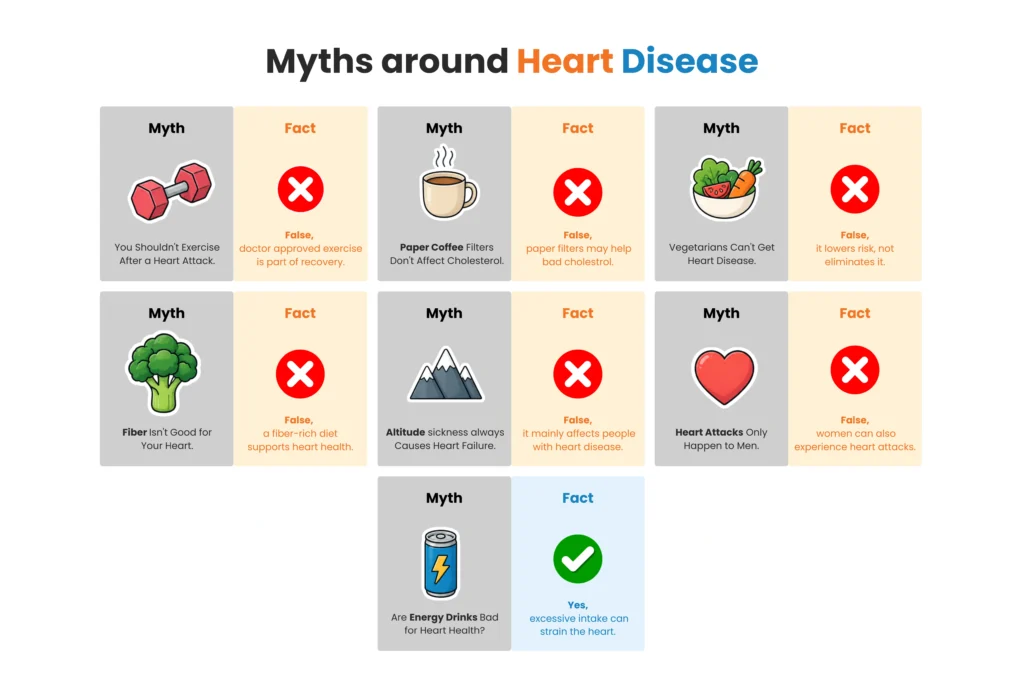
Fact: No, fibers are good and genuinely protects your heart. Studies show that fiber helps reduce inflammation around the heart, which lowers the risk of heart disease over time. According to Harvard Health, a diet rich in fiber is linked to better heart health outcomes overall.
Fact: No, even one energy drink can be harmful. Energy drinks can raise norepinephrine levels (a stress hormone in the body) by as much as 74%, which in turn increases blood pressure. This spike in blood pressure can interfere with the heart’s ability to communicate properly within its cells, leading to arrhythmia. According to Mayoclinic study, even a single energy drink may raise heart disease risk in young adults.
Fact: No, this is only true for people with existing heart disease, not for everyone. According to a news release from the American Heart Association, altitude changes can put pressure on patients with conditions like high blood pressure, coronary artery disease, heart rhythm abnormalities, or heart failure. At altitudes above 9,840 feet, the heart demands more oxygen, even at rest. In some cases, altitudes as low as 8,800 feet can be dangerous for people with existing heart conditions.
Fact: No, a vegetarian diet lowers the risk of heart disease by 15% but won’t eliminate it. This is because a vegetarian diet tends to lower LDL cholesterol and blood pressure, reduce body weight, lower the rate of type 2 diabetes, and increase fiber intake.
Heart disease comes with a lot of noise, half-truths, outdated advice, and myths that often do more harm than good. As we’ve seen, some claims turn out to be true, like the effects of energy drinks or high altitude on an already weak heart, while others, like vegetarianism guaranteeing immunity, are exaggerated. The safest approach is to rely on facts backed by real medical research, not assumptions. When it comes to your heart, a little knowledge can go a long way in helping you make better, safer choices.
Table of Contents